“No one really sees a flower. It is so small. We haven’t time.” — Georgia O’Keeffe
A Childhood Memory and the Power of Perception
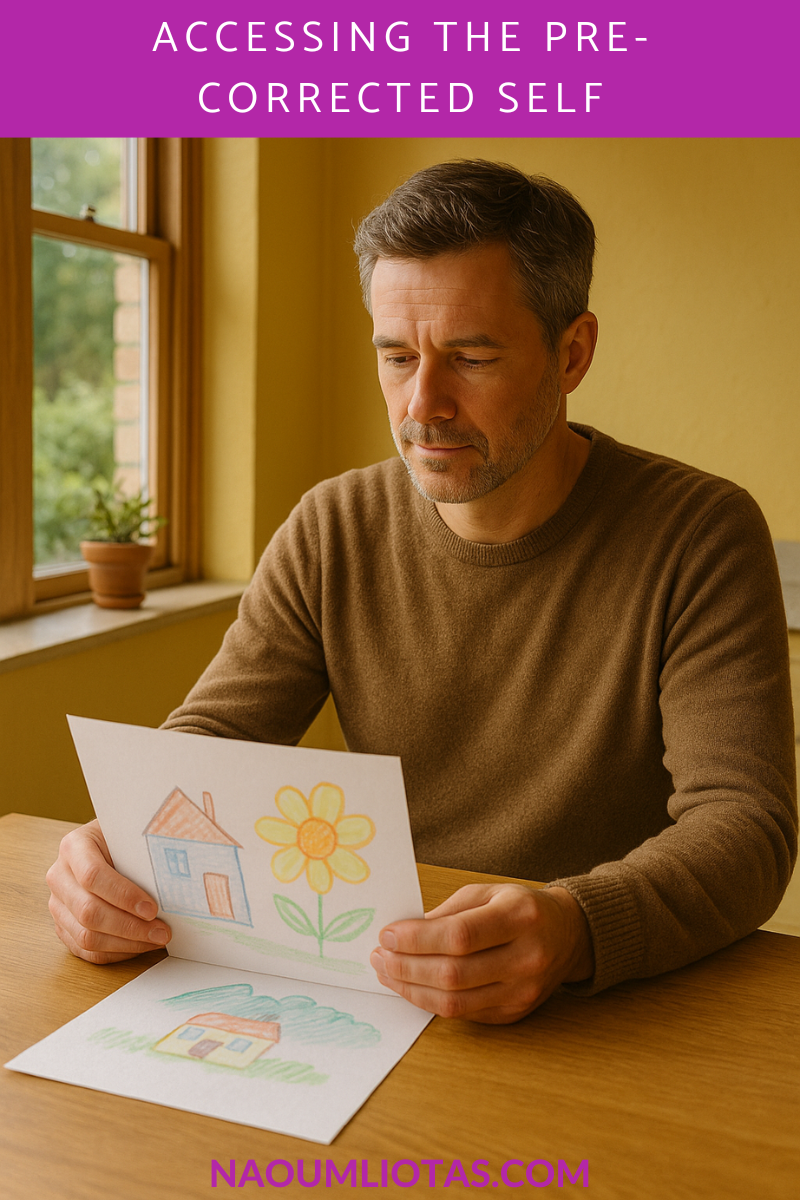
In the early years of school, I once drew a picture in which a flower towered over a house. It was not a mistake, but an act of vision: the flower, in that moment, simply mattered more. Its shape, its presence, the way it opened outward into the space around it, carried a kind of significance that dwarfed bricks and windows.
But a competitive teenager passing by my desk looked down, laughed, and declared the image “wrong.” The flower was too big. The house was too small. Had I not learned about perspective? I remember the heat of needing to explain myself, the urgency of defending what had been a spontaneous act of creation. I didn’t have the language then, but something in me knew I had touched a truth that wasn’t made of rules.
The Field Interruption and the Pre-Corrected Self
From a Gestalt perspective, this is a clear example of a field interruption. The child reaches out in contact with the world, not to mirror reality, but to express felt meaning. And in that contact, a social figure emerges — the peer, the teacher, the adult gaze — that demands conformity. The child is asked, implicitly or explicitly, to become confluent with the social order: to make the flower smaller, the house bigger, the world “realistic.”
Lacking support to hold their own aesthetic truth, the child retroflects. They turn the energy inward. Imagination is redrawn within the lines.
Phenomenology, Perception, and the Poetic Truth of the Child
Maurice Merleau-Ponty, the phenomenological philosopher whose work deeply influenced Gestalt theory, argued that perception is not passive observation but active, embodied contact. The child does not draw from the outside in, but from the inside out. In that sense, the oversized flower is not an error of perspective, but a poetic act of meaning-making. It is the world as lived, not as corrected.
Rediscovering the Pre-Corrected Self through Art
Recently, I came across a post on Facebook about Georgia O’Keeffe. It noted that she painted flowers so large you couldn’t look away. “No one really sees a flower,” she said. “It is so small. We haven’t time.” So she made time. She made the flower a figure so present it demanded the viewer’s full attention.

Reading this, I suddenly remembered that old drawing. And I understood something new: in that moment of social correction, a figure had gone underground. But decades later, it re-emerged. The Facebook post was a spark, but what truly surfaced was a forgotten part of myself — the pre-corrected self.
The Role of Therapy in Reclaiming Childhood Perception
In Gestalt terms, a figure emerged from the ground. The flower came back into view. And with it, the right to see the world on my own terms. O’Keeffe, across time, became a figure of retrospective support. Much like a good therapist, she symbolically arrived to validate a moment that had gone unsupported. This is what therapy can do: offer the relational ground that was missing when we were domesticated, inducted, or otherwise folded into systems of compliance.
There are echoes of this in Nietzsche, who spoke of the child as the final stage of transformation—a being who can say yes to life, who can play and create anew. Winnicott, too, understood that real aliveness begins in play, and that the false self is born when a child must adapt too early to the expectations of others.
So perhaps all therapy is, at its heart, a movement toward the pre-corrected self.
The child who made the flower bigger than the house was not making a mistake. They were speaking in symbols, in scale, in soul. They were saying, this matters more to me. And for a moment, they saw clearly.
Power and Perception in Human Relationships
As Esther Perel often reminds us, power exists in every relationship: who holds it, who yields it, and how it is negotiated. Whether in romantic partnerships or societal systems, the dynamic of who gets to define what is “real” or “important” speaks volumes about whose voice is being heard and whose is being shaped. When we internalise these dynamics early on, they can shape not only how we relate to others, but also how we relate to ourselves.
So we might ask:
What world are we in? Who defines the scale of significance?
If you suspect that a truer version of yourself lies beneath old corrections and quiet self-censorship, therapy may be a way back. A space to recover the scale of what once mattered.
You can begin by contacting me to arrange a session. The flower is still there.

